The High Cost of Forgetting the Moral Foundations That Make Freedom Possible.
❧ The Grief of a Civilization Losing Its Soul
There is a particular grief that settles on the soul when one witnesses a great civilization losing its memory. I feel it daily. The modern age has not merely stumbled into confusion; it has chosen it; parading vice as liberation, even as enlightenment; scorning modesty as repression; and treating chastity as a charming relic from a bygone era, unfit for “modern, sophisticated” people who imagine themselves above moral law. They congratulate themselves on having escaped the boundaries their ancestors honored, never realizing that those very boundaries once safeguarded human dignity and made individual freedom possible.
Yet beneath the noise and vulgarity lies a deeper tragedy: the generations unformed by virtue do not even recognize what they have lost.
“When the foundation is destroyed, what can the righteous do?” — Psalm 11:3
This is the question modernity refuses to answer.
❧ The Virtue Gallery: Caspar David Friedrich, The Abbey in the Oakwood—an Art Meditation
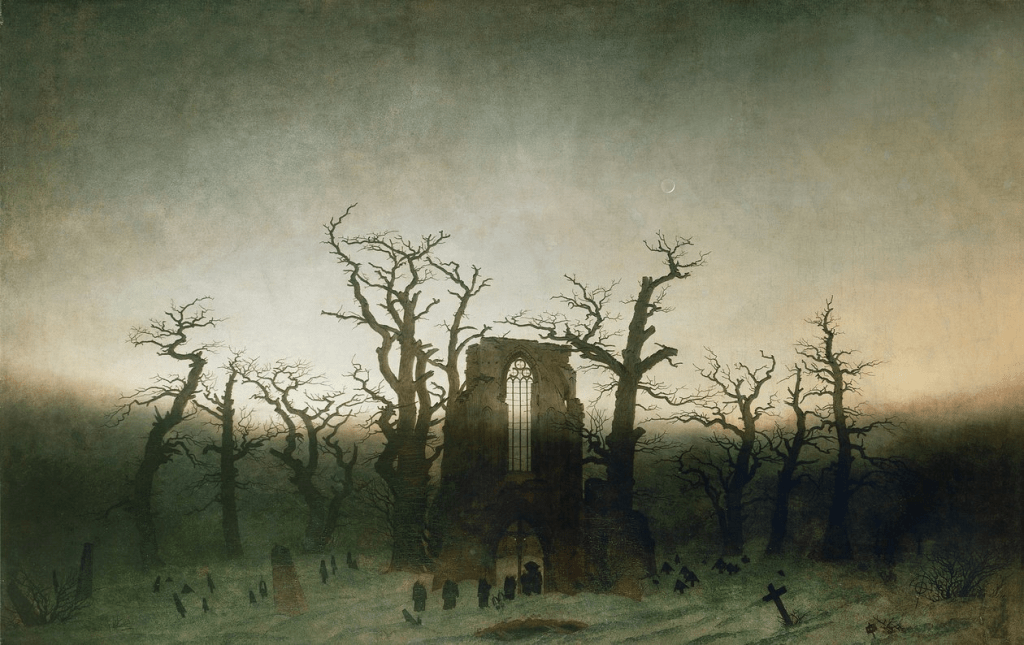
Friedrich does not sensationalize the loss; he dignifies it, inviting the viewer to contemplate what disappears when a people no longer cherish the virtues, disciplines, and faith that shaped their civilization. The ruined abbey stands as a metaphor for the collapse that follows the abandonment of moral law; beautiful in its memory, sorrowful in its present state. And yet, the faint light carried by the monks suggests that all is not lost: even in ruins, the souls of fidelity continue the work of prayer, witness, and hope.
The painting calls us to recognize with clear-eyed honesty what has been forgotten, and to rekindle, even in a darkened age, the small but steadfast light of virtue that alone can rebuild what has fallen into decay.
❧ The Great Unraveling: A Culture Without Its Compass
What troubles me most is not simply the decadence of the age, but the profound naïveté that follows in its wake. A soul without virtue becomes astonishingly blind. It cannot discern what is noble from what is base; it cannot tell the difference between passion and principle; it mistakes strong opinion for strong character.
Such people do not stand on moral ground; they drift and they usually drift down the stream of least effort and most convenience.
And let us speak plainly: neither political camp offers a refuge of virtue and decency. Both left and right showcase different temperaments, and different preferences of vice; but the same disorder of the soul. Both are marked by passions ungoverned, appetites undisciplined, and opinions unmoored from truth. Both suffer from the deep soul malaise of modernity, which is the result of the abandonment of virtue.
“Vices come as passengers, but they stay as invited guests.” — Benjamin Franklin
A society may survive disagreement, but it cannot survive the abandonment of virtue.
❧ The Virtue Gallery: Raphael’s “Cardinal and Theological Virtues“— an Art Meditation
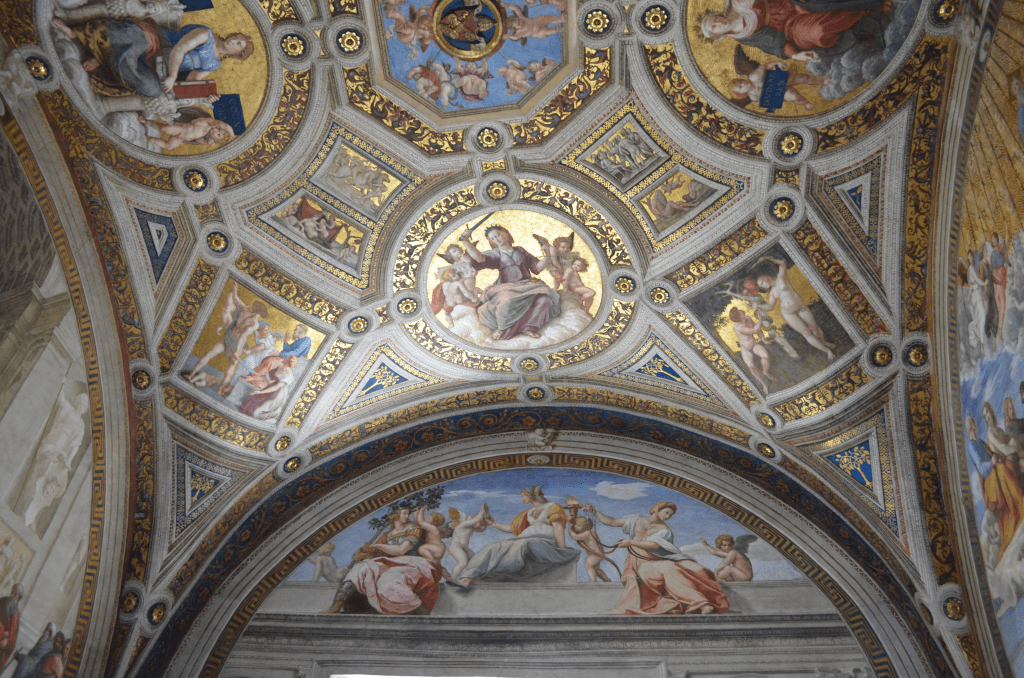
Raphael’s composition presents a civilization in harmony: reason disciplined by Prudence, society upheld by Justice, courage ennobled by Fortitude, and all suffused with the supernatural virtues that orient the soul toward God. In the worldview captured here, virtue is not optional; it is the very scaffolding of a rightly ordered life. When these cardinal and theological virtues are taught, honored, and practiced, a culture flourishes. When they are neglected or mocked, disorder quietly enters, and the moral imagination begins to dim. Raphael’s work is therefore not merely decorative—it is a reminder of what our ancestors knew and what we must recover if we hope to rebuild what has been lost.” Mrs Armstrong
❧ What Morality Actually Means
When I speak of morality, I mean the classical and Christian virtues that shaped Western Civilization and made high-trust society possible:
Prudence — governing thought.
The habit that trains the mind to discern reality as it is, to choose the good, and to foresee consequences. Without prudence, a people become impulsive, gullible, and easily ruled.
Justice — governing action.
The virtue that gives each his due, honors obligations, and keeps one’s word. Justice is the root of social trust; without it, no contract, family, or institution can stand.
Fortitude — governing adversity.
The strength to endure hardship, restrain fear, and suffer for what is right. Civilizations collapse when their people lose the courage to defend the true, the good, and the beautiful.
Temperance — governing desire.
The ordering of appetites so that freedom does not become slavery. Temperance is the boundary that protects individuals, marriages, and societies from self-destruction.
Modesty and chastity — governing the self.
The virtues that guard dignity, protect relationships, and uphold the family; the primary cell of a stable and flourishing civilization. A society without chastity becomes a society without trust.
Charity and honesty — governing how we love and speak.
The virtues that make community possible: truthfulness in speech and love ordered toward the good of the other. Without these, relationships become transactional and society becomes cynical.
These are not decorative ideals. They are the moral scaffolding of a people who wish to remain free, peaceful, and worthy of their inheritance. They taught men and women to master their passions, honor their dignity, and hand down a moral inheritance to their children.
Civilization has always depended on this transmission. Remove it, and the next generation inherits not wisdom but chaos, fear and eventually, violence and coercion..
Children do not learn virtue from lectures but from the lives of those who raise them.
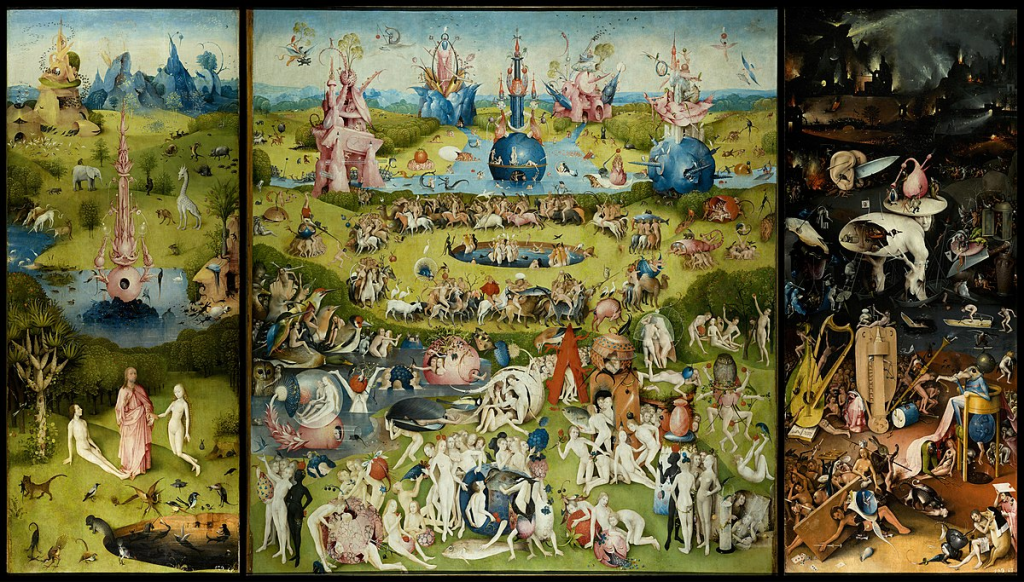
❧ The Virtue Gallery: Hieronymus Bosch’s The Garden of Earthly Delights; an Art Meditation
❧ The Consequence of Abandoning Virtue
When a society stops treating virtue as the norm—an expectation, not a hobby—the moral imagination atrophies. People become lax in conscience, shallow in judgment, and lazy in the hard interior work required to cultivate character.
Virtue begins to appear strange, even suspicious, because vice has become familiar.
A society formed by vice sees chastity as naïve, modesty as prudish, restraint as repression, and self-mastery as a relic from an age it no longer understands. It feels “free and liberated” —though it is anything but.
“Liberty is not the power of doing what we like, but the right of being able to do what we ought.” — Lord Acton
Once virtue is no longer admired and aimed for, disorder and wrong or immoral action becomes normal; and eventually even celebrated.
This is where we stand.
The tragedy of the modern age is not simply that vice is practiced; vice has always been practiced—it is that virtue is no longer an ideal, no longer desired, understood, or even considered necessary.
When virtue becomes optional, trust dissolves and civilization begins to rot from the inside out.
❧ The Path Forward: A Call to Rebuild the Moral Architecture
If our civilization is ever to recover, we must restore the moral vocabulary it abandoned. We must speak again of virtue as something real, binding, and beautiful.
Not something optional or negotiable.
This work must begin in our homes, in our conversations, and in our every day example. Children imitate what we embody. A culture is renewed the same way it decays; one soul at a time.
How can there be peace where there is no order? And how can there be order where there is no virtue?
We cannot force society to recover its senses, but we can refuse to follow it down the long slippery slope into oblivion. We can cultivate in ourselves what the age has forgotten, and in doing so hopefully become the remnant capable of rebuilding what has been lost.
Let the world call virtue old-fashioned. Civilization was built by those who loved what was old and true, and it will be rebuilt by them again.
❧ The Virtue Gallery: Illuminated Manuscript of the Virgin, 15th Century; An Art Meditation on the Mother of Virtue
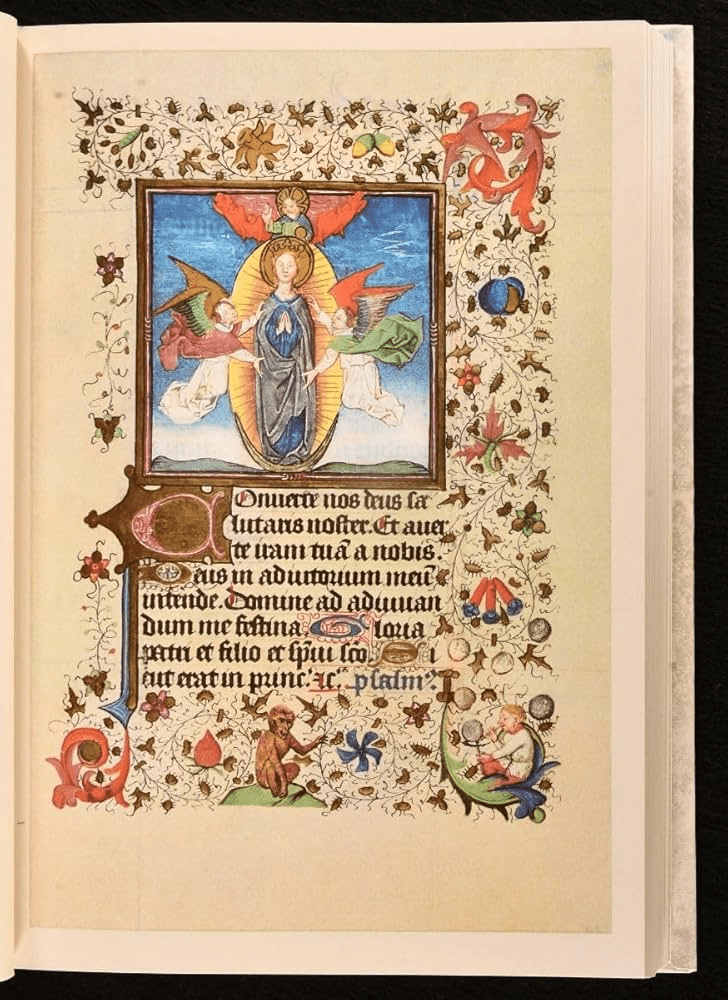
Nothing in this illumination is sentimental. Every gesture, every hue, every flourish in the border proclaims something about virtue and its radiance. Her purity is not fragility; it is the serene and formidable strength of a heart ordered toward God. Her humility is not timidity; it is the clear-sighted recognition of reality, the ability to see oneself as God sees. Her obedience is not servility; it is the courageous assent of a will aligned with the Highest Good, a model of freedom rightly exercised.
The surrounding border; alive with vines, blossoms, and delicate creatures, is more than pretty decoration. It represents the ordered beauty that grows wherever virtue is cultivated. Medieval illuminators understood that moral truth, like a garden, must be tended or it falls into ruin. Beauty radiates outward from virtue; chaos radiates outward from vice. This illuminated page is thus a metaphor for civilization itself: flourishing only when rooted in moral order.
The angels supporting Mary signify what every age once knew intuitively: a civilization rises when it imitates her virtues and falls when it abandons them. Mary is not merely the figurehead of a pious age; she is the template for rightly ordered humanity; modest, faithful, courageous, prudent, pure of heart. To see her enthroned is to see virtue enthroned.
In an era that has forgotten the dignity of chastity, modesty, fidelity, and moral clarity, this illumination stands as a quiet but commanding rebuke. It reminds us that the path forward is not novel; it is ancient. It is not experimental; it is proven. It is the path walked first by the woman who embodied everything our age has rejected, and who therefore shows us, with timeless simplicity, the way home.
“The highest manifestation of life is the union of love and order.”—St. Thomas Aquinas
“Be who God meant you to be and you will set the world on fire.” —St. Catherine of Siena
❦

 thehearthofvirtue.com